24 October 2007

Across the Universe


I swear, Davey, I'm not completely ripping off your format.


I caught this film last night and I must say: It was Taymor-tastic. Julie Taymor directed this much-anticipated movie, which uses songs from The Beatles' repertoire to narrate the emotional upheaval of a few fictional characters living through the 1960s in New York City (and a little of Ohio, New Jersey and Liverpool). I say much-anticipated, and I speak solely for myself. This movie has been on my radar for some time, filmed as it was predominantly in New York, and I'm a hugemongous fan of Taymor and The Beatles.

Most people know Taymor from her movie adaptation of Titus Andronicus, or her work developing the popular Broadway adaptation of The Lion King (or, her upcoming collaboration with U2 and Sony to produce a Spider-Man musical, about which I am [mostly] speechless [it's going to either be the coolest thing ever or forever ruin my impression of her artistry]). Those who still love shows that only live for a few weeks at a time, however, know her from farther back as a director who merges to magnificent effect all kinds of cultural expressions, particularly puppetry. Across the Universe is likely the most mainstream, Hollywood-happy film Taymor has yet made, though it's hard for me to say because I have still not seen her Frida. Yet she still manages to incorporate more-theatrical elements at times, such as huge puppets, mask work and "penny arcade" sequences (as she refers to the animated montages in the Titus commentary).


I have to agree with the The Washington Post review that laments the unspectacular story and theatrical unity of the whole thing. I expected more from Taymor. However, I believe this review neglects the intentions of the piece as well, which is the poison pill of any critic that swiftly renders his or her critical virility utterly inert. As I understand it, Taymor aspired to create a story based solely on The Beatles's music and lyrics and the cultural goings-on of the period in which they were created--preferably a story with resonance to a contemporary audience. In this aim, I believe she succeeded, whether or not I appreciated the end of the film. (I didn't. There needs to be a separate 'blog entry for my feelings about double conclusions in films of late.) And ultimately I don't believe the film should be judged on its merit as an outstanding or well-constructed musical, because I don't believe it was aiming for that specific genre. Nor should it be judged on how profound a statement it made. The Beatles, after all is said and done, were pop musicians. On that basis, I find the movie a success because I enjoyed it.


Puppets and pop music are figuring into my creative life a lot lately. Or, rather I should say, figuring into my fantasy creative life lately, because it's all in my head, nothing done got creatited yet. Heather and I continue to express mutual enthusiasm for creating a Punch & Judy act betwixt us (a plan put somewhat on hold during performances of Prohibitive Standards on account of my breaking her toe with a chair), and I just keep thinking more and more about the kind of theatre I want to make for myself, which invariably incorporates popular music. Part of the satisfaction for me of the "homework assignments" during the development of As Far As We Know was the awareness that it meant I got to use one of the many pop (or indie) songs that had been scratching my itch of late.


So how does one begin to find one's creative voice, one's unique expression, in all of this? How do you encompass all the vast and profound experiences of thirty years into a moiety of melodrama? I've no idea. But I do believe I'm gathering material for my nest as we speak. The female creative influences of my life share some qualities in common that I seek to emulate, or at least steal with great admiration. A certain approach to creation as perception, a sort of found-object art, only with people and behavior rather than only objects. A release in the surreal, in the way interpretation of something common can make us notice it anew. Compassion, garnished with perspective. And meanwhile the many men of my motley career continue to offer their common, yet still sustaining, examples to follow: the value of discipline and having something to prove, the energy inherent in competition, the unique forge of approaching some things on one's own.


And why now? Why am I becoming, slowly, so hell-bent on directing something, or at least creating something to call my own? Is it the same urge that drove me into play writing after working showcases for a year here in New York, a frustration with things not going my way, or is it a realization that I can't get by on the same skills I used in my twenties, or is it something deeper? It's a curious, and somewhat unrelenting, urge.


I needs me some puppets!

22 October 2007

As They Say In This Biz, That's All There Is...


So Prohibitive Standards has had its last call. Yesterday we ran the scenario for the last time, and received our last applause. I have, of course, work coming up to comfort myself with. This weekend is the The Office convention at which a large group of TNT actors (including this guy) are performing, and then there's the chance of participating in First Look again, the acting company of NYU's graduate playwriting class. That latter comfort is doubly so, as the playwright providing the material in this case is an old friend and comrade of the boards, Avi Glickstein. Thereafter, no work is waiting, and my intention (the which we hope will finally be fulfilled in part owing to publicly confessing it here) is to enroll in an audition class to brush up the old chrome. All good things. Still, one goes through a feeling of some grief whenever a show comes to a close, especially when it's one you've made yourself.

Some retrospective analysis is owed, too. I realized, just before we opened, that I was playing three-and-a-half characters (I'll explain in a minute) and that each of them had something to tell me about where I stood with myself right about now. When a "creactor" works on a show with his or her fellow "creactors" and "crewriters" and "credirectors" (Nat: my readership may never forgive you that term) some of that creactor's personality and personal life inevitably end up in the show. Get closer to the particular contribution of the given contributor, and you get closer to his or her story. In the case of the creactor, this is his or her character creations. So: My characters . . .

My primary character (that is to say, the one with the most involvement with the story) was Joe "The Barber" Barbara. This was an actual gangster of the time, about whom you can read more at the Prohibitive Standards research 'blog. I made great efforts to steadfastly ignore and refute any historical accuracy in my portrayal of the goon. I think it's probably very unlikely that he was even in Scranton in December of 1933. So my Joe ended up being a rum-runner on the run with his girlfriend (Heather Stuart reprising her most popular role of Miss Dimple) making a last shipment to the Jermyn on their way to settle down in Kansas. He was a control freak, accustomed to using the threat of violence to turn negotiation to his advantage. He also suffered from a strange phobia, whereby he passed out whenever anyone touched him. His arc was to bluster about trying to beat everyone at everything, gradually realizing throughout that control isn't terribly satisfying, and that to be truly safe he has to allow himself to be a little vulnerable.

My secondary character was Buddy "Bud" McPherson, a Scranton cop who had a working relationship with the owner of the Jermyn's supper club. Bud was an orphan with strict morals who grew up under the tutelage of the church and savored stage performance all his life, from vaudeville to musical theatre. He also was a teetotaler, and prided himself on his ability to stay on the straight and narrow. Unfortunately, he was also a total coward. Bud feared just about anything that moved, and only succeeded as a cop in how amenable he was to compromise (a suitable tactic in the permissive nature of Prohibition-Era Scranton). His arc was thinly penciled into this show, as he was more of a device than a fully formed character. Most of his transformational experiences took place offstage, in the form of finally resorting to drink to try and overcome his cowardice. Every time he entered, he was a little more intoxicated, until finally he makes his last entrance to confess his failing. In so doing, he comes to realize that nothing was quite as bad or threatening to his person as he had made it out to be in his imagination.

Finally, my tertiary (and a half) character was an anonymous hobo. Anonymous, that is, until the end, wherein it is revealed that he is in fact John J. John, long-lost husband of Rosie O'Grady, the supper club's owner. That revelation ends a series of revelations in which it is revealed that Joe and Bud are also their long-lost sons. (The men of the family all fell overboard off the Titanic, feared to be lost for all time.) But before all that, the hobo is just a hunched, obscured, mumbling and shuffle-footed vagrant who wanders in off the street. No one can understand a word he says, but he's on a mission to find John J. John (having no idea that he is him) in the hopes that he can return the man's bond certificates to him and acquire from him some information as to his own identity. For twenty-one years, J.J.J. has had amnesia and scoured England and the east coast of America for hints as to his true identity, but he makes no real headway until he drinks the scant remains of Rosie's bathtub gin (brewed from a batch of perfume called "Total Recall") the which instantly returns his memory of himself as a sophisticated, articulate and successful businessman.

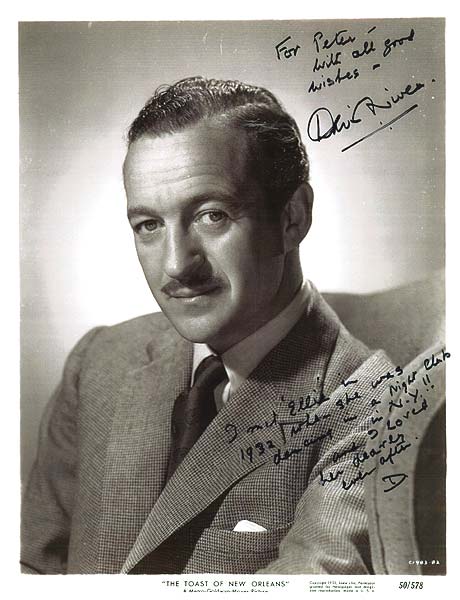
Above all, the hobo was my favorite role to play. There's something about a (virtually) silent character that I find very appealing. I think, to me, it's a bit like classical music, the way it invites the audience to have their own experience, rather than spend effort trying to interpret a lot of verbal specifics. Plus, it's just beautiful. People gathered in a room, in silence. It was a welcome contrast to much of the rest of the show. My second favorite character, Joe, also ended up in an unspoken scene with a character we included who represents a young (and uncharacteristically slender) Orson Welles. The thing that was great about Joe was that he was literally all talk. Threaten as much as he liked, he could never actually touch anyone; until, that is, he let go of the need to get his own way. Bad was fun at times, those times mostly having to do with when I was working against his cowardice. J.J.J.-realized had a mere cameo, but he did allow me to say, in my own take on David Niven, "Where the devil am I?!"

What does it all mean? Well, I think I'll leave it largely up to interpretation. Them what know me probably read along and thought, "Yeah, that sounds a lot like Jeff." I find it interesting that I ended up creating and playing characters who all--one way or another--didn't know who they were. I also find it interesting that I played twin brothers, one sensitive and cowardly and the other a menacing blowhard, and never the twain shall meet. Beyond that, I think my creations and interpretations were largely very similar to my efforts in recent years to move past the doe-eyed, milquetoast type in comedies. Last Zuppa show it was a lazy drunkard git cum tarnished opera diva, and now Heather and I are aiming to make a show based on the Punch & Judy tradition. I may never leave behind the Harold Lloyd/Pedrolino type. I guess I wouldn't want to, not wholly. It's just good to try to explore all the angles of one's self, especially in a medium so conducive to that exploration.

Prohibition is over, the noble experiment concluded. Who needs a drink?

16 October 2007

I Did It My Way . . . With a Little Help From My Friends


Lately I have been wondering where I am headed with this whole Zuppa del Giorno thing. That seems a fairly natural consideration at this point. I mean, I just turned thirty years of age. For the past five years I have given a significant portion of my career time to working in this milieu, and in that time we have achieved many of the seemingly impossible goals we set for ourselves, such as simply maintaining an improvisatory theatre troupe for so long, going to Italy to teach, learn and perform, and developing work that honors and (I believe) advances a tradition of theatre oft neglected this side of the Atlantic. Add to that the homecoming nature of Prohibitive Standards (with David as director again and returning to completely improvised dialogue) and there's very little reason to worry over a need for personal reflection.

Yet I worry. In spite of investing so much and believing even more in embracing the unknown, it is disturbing to feel a lack of drive in this work. Perhaps it's very simple: We still don't know what next year's mainstage show will be, thus I have nothing specific to keep ruminating on at odd moments during the year. I think, however, it has as much to do with that uncertainty as it does with a certain frustration on my part. This frustration may best be characterized by a metaphor concerning the actual action of performing improvisation.

To wit: In long-form improvisation, one needs a certain familiarity at least with one's stage partners. In commedia dell'arte, this is enhanced by established bits of business carried from show to show, called lazzi. It's necessary to have some things understood. However, it is equally necessary to have a sufficient balance of completely spontaneous, unrehearsed moments--to have them, recognize them and take advantage of them. That's what gives the form its life, its truth and the lion's share of its joy.

And here am I (in the larger picture [the one in a five-year frame]) feeling as though it's all planned out. The scenario has solidified to the point whereat it is almost calcified. And more significantly, I feel as though I don't have quite the same things to contribute to breaking it up as I used to. When I started this work, I was twenty-five years old, with most of my background in stylized comedy sampled from sitcoms and farces. I leaped in headfirst, heedless of danger, and accepted everything I was told. My energy was boundless and I was determined to do wild things with unrelenting abandon. So it seems to me now, at any rate. Over half a decade, I have changed, and the work has been through many changes itself. It's difficult to distinguish between the two, speaking quite frankly. What changed in a given circumstance? It or me?

I suppose that's just one of the mysteries of life. And these changes in direction can't always be controlled, even when they're perceived to be happening. The challenge is to change with them, and carry the momentum forward. Accept and build. "Yes, and...."

What fun is it, knowing exactly what to do next, anyway?

15 October 2007

I Heart Improvisation


Way back at the end of our first week of running Prohibitive Standards, I began a 'blog entry, the which I have not returned to since my first true day off. I quote--here, after the second week of performances--said beginning:

"We had our first genuinely difficult performance of Prohibitive Standards yesterday. It was the end of our opening weekend, a weekend in which we performed five shows (or six, if you include our invitational dress rehearsal) after weeks of arduous development. We were bound to lose some steam by the time we got to that final show of the week, and it didn't help that our audience was the smallest and least responsive yet. (There are a number of blessings/curses to performing on a university campus, not the least of which is some guaranteed audience numbers . . . as a result of the show being a requirement for theatre and history classes.) I can't ever shift blame for a disappointing show onto an audience, however. Even a show as dependent on audience involvement as this one.

"All comedy is rather dependent on a receptive audience. I mean, that's how you know you're reaching an audience with a comedy: laughter. Immediate response. Now, improvisational comedy, that's the most potentially insecure comedy of all. Think of how the form has translated into television and film thus far. Both the Christopher Guest films and--to a greater degree--a show like The Office depend on awkward scenarios and seemingly oblivious characters for their humor. There's an interesting overlap of what I've been doing in relative anonymity for my entire acting career and the American public's interest coming up: The "The Office" Convention in Scranton, PA. I and about fourteen other actors affiliated with The Northeast Theatre will be doing an improvised performance as a part of the event, directed by Samantha Phillips and written/structured by Steve Deighan."
Where am I going with this, you may ask (if, indeed, you are even bothering to check my 'blog after such extended absences)? Well, after two weeks of performing this entirely original piece, I have to confess that some rather brutal reality checks have been in order. The first of these is to admit that our relative success in the opening weekend had rather to do with an extended version of "opening night syndrome." For you non-theatre-o-philes, this is the phenomenon whereby all community theatre sustains life. Essentially, it is the equation effort + community involvement = mutual necessary success. In other words, when ensconced in a community that comes to need your success to verify itself, success is somewhat guaranteed in the response from said community. They are supportive in spite of themselves, because they have come to value you as a representative of their community.
That's not to say we didn't work very hard, nor that Marywood's opinion is invalid in any way. Rather, it is to say that we didn't have the opportunity to face the real challenges of actors and collaborative playwrights until the glow of opening a unique effort faded and died. Rather farther, it is to say that we have begun--in this second season of three--to find a sincerity and danger to the show that we could barely conceive of in our packed houses at Marywood.
So seems it to me, as biased and involved as I may be at this time.
This weekend, we came upon the remarkable stage of development in which we toyed with core elements of the show. All the things we were terrified to play with when we finally got a working plot on its feet--intentions, motivations, lazzi--have become fair play, and just in time, too. It was getting terribly stale, and hope was draining like hooch into a 1916 sewer. The last two shows we've done were well received, but more importantly we found truth in them again. And this time, the truth is born of the moment itself more than the desperation of making something comprehensible (of course, a sense of desperation doesn't hurt, either).
I acknowledge: this has been a terribly abstract entry--particularly for them what haven't tried to succeed at long-from improvisation previously. I hope to remedy that in later entries. For now, try and relax in this little axiom:

"Getting it 'right' is ridiculously unproductive. Make mistakes constantly, and make them boldly, or suffer from limitation and stagnation."

01 October 2007

Making a Stand(ard)


Hi. I was wondering if I could be let back into your life. You can't see me now, so I'll just let you know that I'm standing, in a trenchcoat, outside my car, holding a boombox over my head and looking mournful. Sure, the boombox is playing "Life Is just a Bowl of Cherries" rather than something romantic that we got freaky too (like "The Thong Song"), but that's just because I'm stuck in the '30s, and can't get out. At least, not until October 21.

Some people are genuinely upset with me for being so absent. Not so much on the ‘blog—that, at most, inspires increased frustration with work-induced boredom—but more in general. I never write. I never call. The least I could do is ‘blog every now and again, just so you know I’m still alive as you sit there, reading in the dark without your glasses, two miles in the snow uphill both ways. I am sorry, truly. I have had a worry or two of my own, you know. Nothing to rival your worries, and of course the greatest worry I have is that something terrible would happen to you and I wouldn’t know about it because I have been so selfish, and unworthy of your thoughtful consideration. You have, at the least (as you lie in traction from your tragic tractor trajectory) this comfort: It has been in the name of Art.

And fart jokes.

Look here to see what has been so occupying now that I’ve not been available. Oh, I can’t trust you to links! It’s Zuppa del Giorno’s first original creation in a year-and-a-half: Prohibitive Standards. If you do take the “here” link above (and how much better it is to live in the here and now), you’ll see that a tremendous amount of work has gone in to creating this show, and the ‘blog(s) don’t hardly reveal but half of the actual salt-water work (that is: sweat and tears [thank you, Friend Kate]) what’s gone into this production. The rehearsal room, after all, is where all the material for Zuppa’s shows really springs from, and for the past three weeks we’ve been gathering in a room (or two) to make our baby.

I had previously attempted to ‘blog about the process of that, but never got very far, because I was constantly off to learn music, or watch movies, or try to master a front handspring. OR, to balance my life. Because that’s a special effort too, when you’re an actor of somewhat modest means working out of town. It’s important to acknowledge that aspect of The Third Life©. From balancing one’s checkbook, to reminding one’s parents that he or she is not, in fact, home to be visited, to maintaining some sense of home and personal identity amidst characterization and shacking up in someone’s guest room, the traveling artist has a lot to contend with. Not that it’s not without its perks, either. New experiences are fantastic fuel for creative endeavor, and it’s easier to obsess (constructively, we hope) without frequent reminders of responsibilities.

One of my previous attempts at ‘blogging on this process was entitled “A Host of Angles.” I’ve written to some extent already about the unique process of creating a show from improvisation in my experiences with UnCommon Cause Theatre and Zuppa del Giorno, but never since opening the Aviary have I been so close to the process, nor has it culminated in quite the same way. Prohibitive Standards will be performed in a structured improvisation style. It will never solidify entirely. It will always be different. This means that the same concepts applied to making the show from the ground up will be applied in making it work when the curtain goes up. That creates an intense energy in which one has to set rules for oneself in order to be ready for anything that could happen on stage. We’ve constructed a scenario—or sequence of necessary actions—as our rules, within which we can play and stretch and improvise. In this way, the energy of a performance is very much like live sports, for both the participant and the observer. Everyone’s eager to see what happens next.

But “A Host of Angles”? Well, the most impressive reminder I was receiving about this process when I came up with that title (a lifetime ago, on September 15) had to do with the abandonment of structure and the necessary mastery of the elements of a play involved in creating one by committee, from scratch. In a more standard process, there is a sequence of events and a hierarchy of authority. Typically, the play passes from playwright to producer to director to actors, with very little passing back, and each party has a sequence of gradual development that results in a finished product. In creating a show in the living tradition of commedia dell’arte, however, everyone fills each role in some fashion all the time. One moment you are discussing character arcs, the next you’re leaping around imitating a boiling tea kettle, and still the next you’re trying very hard to be open and objective as you argue for more time for acrobatic training. Rehearsals end, of course, eventually, but they never really do, because everything you see, feel and do at all times goes into the soup, and as a producing playwright directactor, you never stop thinking about and discussing the show. Rather than a sequence of creation, you are coming at an intangible goal from every angle at once, and a lot of the time it feels as though you’re completely wasting your time, spinning your wheels while nothing productive takes place. But I leave out here, as something too obvious to mention, a critical ingredient in this creative soup: Faith.

However we got here, here we are, with a complete scenario that we may even manage to remember and properly reproduce on preview night, this Thursday. It has been a tremendously ambitious project, involving collaboration with Marywood University, regular workshops and training sessions with students and a good deal of marketing. Not everything has turned out the way I had hoped: the student actors are not as involved in the story as I would have liked, there's less emphasis on vaudeville than I had imagined and our physical daring, so prominent in the last two shows, has taken a backseat (necessarily) to an intricate story. However, I am very proud of what we’ve made, and excited to add an audience. Everyone is doing something they never thought they could do before, including me.

What new am I doing? I’d like to keep it a surprise for anyone who can make it out. Let’s just say that my embouchure hasn’t been in this good a shape since I was fifteen.